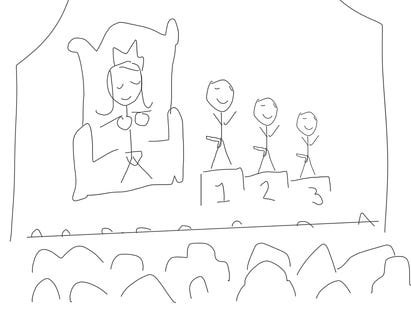
Long before Onlyfans existed, I met its future owner in a hot tub in a penthouse at a camgirl afterparty at a porn convention in Las Vegas. He was a sweet, quiet guy everyone called Leo. He ran MyFreeCams, the platform that my friends and I used to do livestreaming sex work. I remember we all thought it was interesting that he didn't seem to be sleeping with any of the girls. At that time, probably around 2013 or so - if you were a girl who wanted to make money getting naked online, your best bet was to sign up for a livestreaming camsite. My friends and I, all in our early 20's, lived in camhouses, traveled to conventions to camgirl live, used camgirl merch, discussed strategies in camgirl-specific forums. Of all the camsites, MyFreeCams was the biggest. Most camsites worked like this: You, a hopefully attractive girl, turn on your webcam and livestream for an audience. The audience is all in a chat room, very similar to Twitch. They can chat live with you, and also with each other. You get money through two main methods - either live tips to the room, typically witnessed by all the other members of the chat, or you can get taken private, a one-on-one pay-flat-rate-per-minute show. Different camsites focused on varying points on the spectrum between these two methods. But everyone knew the serious money was in the live tipping. Privates capped you at around ~$3/minute, but tip-based income could average up to $20/min The (oversimplified) psychology behind high earners for livestreaming went something like this: You, the aforementioned hot girl, have an established audience of regulars in your audience. Each man can see the other men talking to you and giving you money. The men are implicitly ranked by dominance, which is determined by how much attention you pay to them, which is in turn determined by how much money they give you. This leads to whales, and soon 80% of your income comes from 1-2 big players. These people are incentivized not just by making you happy, but by making you happy in front of all the other men. The system is competitive. To be a good camgirl, take your biggest tippers and put their names in lights behind you so everyone else can see. Call them heroes, knights, grant official titles. Only the richest will survive. I signed up for Onlyfans in 2017 (before Leo took over), and I thought it sucked. I posted some cute videos or whatever, but nobody used it, the tips were negligible against the $10k months I was accustomed to. The problems were obvious to me - it was impossible to have whales compete against each other. What were the incentives for big spending? Of course I was wrong, unable to see outside my local minima. Onlyfans ended up dominating, decimating the previous camgirl landscapes. Nowadays, camming audiences are at a fraction of their previous highs, and many of the girls who still cam are using it explicitly as funnels into their Onlyfans. So: How did it succeed so hard? Onlyfans Figured Out How To Scale ConnectionIf camming works like this:
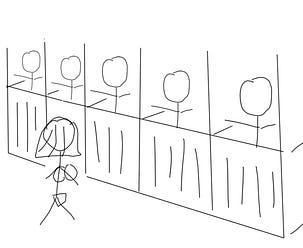
then Onlyfans works like this
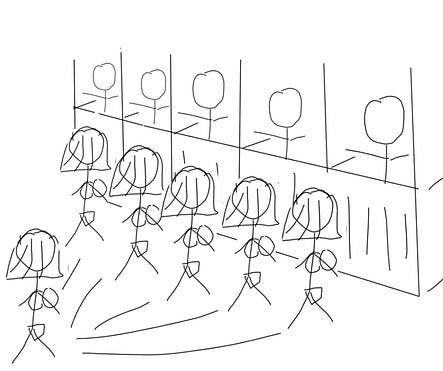
Onlyfans maintains the dynamic that made camming so successful - direct, live connection with a girl - but manages to make it feel individualized. Instead of having to pay a lot of money to rank against other men, you can pay a little money and enter a pussy paradise with not a single other man in sight. Onlyfans lends its design towards isolating the men from each other. If you're a horny dude, the existence of other horny dudes is a fleeting shadow, a ghost only hinted at implicitly through seeing 'like' counts on photos or occasionally subscriber count numbers, for the rare girls who make it public. From the girls' perspective, OF is designed to make this easy. There's a bunch of settings for mass messages and filtering of who gets those messages, so that a thousand brand new men may at once receive the blessed 'hey babe, u up?', a virtual realgirl gazing directly into their own eyes, just him and her, horny, together, forever. Maybe OF is actually more like:
This is likely why agencies have become such a strong force behind the most successful OF models; they offer duplication as a service. The way agencies work is this: You sign up for an agency and pledge them some percentage of your OF income, and the agency takes over handling a lot of the trivial labor involved in copy-pasting the sense of your personal connection across the stables of men. I've never used an agency, but I was curious how they worked. Back in 2020 when I had a bunch of publicity about OF earnings, I started getting pornily headhunted, and I ended up talking to a man who claimed to run the largest OF agency at the time, and I asked him a thousand questions about how it worked. He said he had rented out a cheap warehouse somewhere outside of new york and staffed it with a bunch of minimum wage workers. These workers would log onto their clients' accounts and chat as them. The chatters got a quick sheet with a bunch of facts about the girls they were impersonating to make sure they were being consistent about basic life things (like general personality/tone, where the girl lived, etc). Their primary goal was to sell content directly to the men through DMs. "You have to set your monthly subscription price to $5", he said. I didn't like this idea, I was at $19 and didn't want to seem like I was devaluing myself. "No, we have the data. Girls' incomes steadily increase as you drop the subscription price, up to about $5, but below that they decrease again." He was running a very different business model than me. I saw a monthly subscription price as an important part of my income, but he viewed it as trivial. The real money was in the DMs, upselling was the goal. The purpose of a $5 monthly sub price was to be low enough to get as many men as possible, but high enough to filter out the men who were too stingy to spend anything in DMs. You didn't want your minimum wage warehouse workers wasting valuable time by trying to sell to a guy who wasn't going to put out, after all. I couldn't see it at the time, but he had touched on the same principle that caused camgirls to earn more through tips (as opposed to a flat minute rate). Building your business model around a monthly subscription results in a ceiling on how much each guy is willing to pay. If your model is custom-milking every guy with direct, responsive connection, the sky's the limit. Since then, agencies have only grown. Probably the vast majority of high-earning OF accounts are being run by agencies, which take a substantial fraction of the money (the amount varies widely, but often a minimum of 50%, on top of the 20% OF already takes). Agencies are more customizable, more sophisticated. One of the more full-service agencies I talked to would do everything; they'd fly a girl out to a fancy airBnB for a few days, shoot a huge amount of content, and send her back. They'd do all the chatting, splice up and organize all her content, build her payment structure, funnel in new subscribers. She'd take 10-20% of the proceeds and never log into her Onlyfans once. DripsEventually, the commonly known dominant strategy became known as drips. You'd film an opening clip, typically 10-30 seconds, where you said something vague and indicating horniness. Then you'd film clips in succession, showing a progression of you stripping, teasing, all the way to masturbating and then climax. The goal was to get a set of videos that could be sent as though they were plausibly being filmed live. People would send out the first video en masse; a certain percentage of subscribers would respond, and then you'd say sexy things and then send out the second video, for a certain trivial price (typically $3 or so) to unlock. A certain percentage of those subscribers would pay to unlock the video; then you sext a bit with them, then send out the next video in the series, usually for a slightly increased price. Eventually you work your way up to the final video, typically a climax, which could be just 30 seconds in length but often sold for $20-30. I asked a manager once if he typically had girls film multiple drips at different times of day, because if you have light pouring through a window for a girl who supposedly lives in a place that's dark, it'll be a dead giveaway that it's not live. He said no, it doesn't matter. The men basically never notice or care. At one point, trying to understand agencies more, I created an account as a horny man, attached a credit card, bought access to a high-earning girl I knew was run by chatters, and bought through a drip series. It was shockingly bad. She texted me something like "hey babe you horny", and I was like 'yes," and she said "let me show you what i'm doing" and then sent me a video of her in what was clearly a well-lit studio, she was wearing stilettos and dressed in a skimpy santa outfit, with perfectly curled hair and heavy makeup, bending down to show off her ass in a performative pose. There was no way she had just filmed that. It was insane. But it didn't matter. It took a long time for me to come to terms with the fact that for most men, they don't care about reality when it comes to their supposedly connective porn. They aren't tracking you for signs of genuine enjoyment; to them, your personality is simply a vessel with which to certify that your breasts are genuine. I know a girl who was typically very warm and direct, made personal connections with the men who subbed to her. She experimented by making a free page (a type of OF where you don't have to subscribe, but instead charge higher money for access to individual stuff on the feed), and on this she hired a real trashy chatter, who would spam men nonstop with stuff like 'HEY BB U UP? MY PUSSY HORNY XOXO LOOK AT ME WET NOW'. And yeah - her income shot up. My point is, the fact that men don't actually care about individuation much really lends itself to the scalability of connection. A hundred guys will think the things a girl says in her drip video were in fact filmed live and directly, uniquely for them, and be completely unable to notice that it's not, that blazing daylight outside despite being 10pm, that she never says their name in the video. You can duplicate an entire human with low resolution and as long as she appears vaguely fertile, they will never notice. I have a lot of positive things to say about men, like I will staunchly defend being empathetic towards them, but this is one avenue in which my hopes about them were repeatedly, regularly crushed. (This is partially why I love escorting. I do not get this feeling from my escorting clients at all, and the structure of it fuels real, meaningful connection, as opposed to Onlyfans' systemic dehumanizing) The Terrifyingly Brilliant Method of Acquiring New CustomersRemember when Onlyfans threatened to ban porn? I think this was probably a stunt, meant to call public attention in a game of chicken with the banks that were threatening their ability to handle payments on the platform. I don't call it a stunt lightly. Stunts require a level of cleverness that is rarer than we'd hope. When I was a bit more naive, I assumed that Tumblr banning porn must have been a clever move, because people running companies were supposed to be clever. But no, it was very stupid. Companies make stupid moves all the time. But Onlyfans leadership is ancient and well-versed in the world of porn, hearkening from the primordial internet soup of 2004. This wasn't a SFW platform that got slowly hijacked by nudes - this was a NSFW website, founded for NSFW creators, owned by seasoned, battle-hardened, semen-crusted company leadership. That, and I talked to the guy who founded ██████, who told me that Onlyfans was a client, and that the porn ban was certainly an intentional ploy to garner public outrage to help pressure the banks into being less of a little bitch. I don't know for sure if this is true, I didn't verify by other sources, but he was in a position to know. My point is, I don't think OF leadership is dumb. And I am making this point because you might naively think that they're dumb when you hear about their marketing strategy, which is nothing. They do nothing. Sure - they have ads, but have you ever seen an onlyfans ad, by onlyfans, in the wild?
Before OF, websites themselves were responsible for providing traffic to their own creators. With MFC (and as with every other camsite), the front page features a long scrolling list of models, splayed out for your browsing pleasure. MFC was responsible for getting men onto the website (typically via ads on porn sites), after which the girls would compete against each other for capturing the attention of those men. And that competition was fierce! The algorithm on the front page prioritized income per hour of camming, such that if you were online, you had to hustle, or risk dropping in visibility and thus dropping even more in income. There was a leaderboard for income per month, where you could see the girls ranked against each other by who had managed earn the most out of the funneled men. This whole thing was intense and distracting. Everyone's effort was focused on competing inside the system. As far as I know, I was the only girl who tried marketing myself outside of MFC, generating my own funnels on reddit - but even then, I did this more as a side project, not as a main source of income. By contrast, OF's internal discovery system is pitiful, mostly limited to a small 'suggested' section on the side. I never once heard any OF girl rely on a marketing strategy that involved internal OF discovery systems. No - instead, OF turns all of its creators into their own ads. If you're a girl who's signed up for OF, made your account, you might sit there - now what? Nobody subscribes to your account. OF does not hand you any views by virtue of being on the platform. If you want a man to pay you, you have to go out there and find him. You have to be the ad. I cannot overstate the degree to which this radically transformed the online landscape. Practically overnight, an explosion of Onlyfans ads went off in every corner of the internet as girls migrated en masse to throw their own naked photos in front of the faces of every man they could find. Sexy subreddits I used to post nudes in with no issues suddenly started instituted rules against me and every other girl who had a link to her OF in her bio. Instagram started banning accounts that linked to OF, and then sometimes even accounts that linked to any other website which then led to an OF. Even Fetlife, famously and loudly pro-sex work, ended up conceding by introducing a "hide sellers' option on their front page, so people could filter out any girls posting titties for profit. The sentiment towards online nudie girls went from fond-neutral to outright hostile. As an aside, I do find this kind of amusing. Getting paid for sex places women into a traditionally masculine role - they become the pursuer, trying to extract something they want from the opposite gender, competing amongst themselves to be the most attractive to otherwise uninterested targets. In a sense, this forced masculine areas of the internet into adopting defensive feminine norms, as they banned any 'predatory' behavior and started socially deriding any sellers as being gross or embarrassing. But anyway - I suspect that if OF put effort into internal discovery, this would likely destroy the motivation of a lot of its users from doing their own marketing. This is also likely why OF can get away with taking only 20% commission, as opposed to other sites' 50-80%; they save a ton by not having to run ads. Agencies primarily handle sexting, but the 'funneling new eyes in' part is stuff they also profit from. I don't know much about this. I got the impression from various calls that pre-OF, big multi-million follower instagram accounts (typically meme accounts) would make money by selling ads disguised as not-ads. There was no visible platform for this; the guys who did this would sell these manually, in jealously guarded telegram chats. After OF, many of these pivoted to the boobies, posting thirst traps disguised as casual memes along with all the rest. Some of those big insta accounts would switch to founding agencies, or people from agencies somehow made their way in, and they would make deals - "Post my girl on your page, we pay you $400". I wanted to get in these groups, and I tried, but it seemed like there were no actual models allowed in these groups, and I couldn't find anybody to let me in. If someone was managing multiple girls, he'd often use these together. It was pretty common to see a thirst trap of a sexy girl, go to follow her page, find it was private, with a message "I'll approve follows, but first you have to follow [another sexy model]." You'd navigate to the next model's page, and she would have the same message. You went all the way down the chain and had to follow each model's page in order to get, presumably, approved for all of them. I never was part of this world, and am not the person to be able to tell you more detail than this. I really hope someone does a writeup about how this worked, though! There's a lot more I can say about the minute details of OF advertising and sales - from the methods I used to construct systems to scale my own advertising, to best practices for posting frequency, to how to take the sexiest possible photo that converts the maximum number of clicks, but that would be a blogpost like 3x the length of this one. Maybe I'll do its own post in the future! Onlyfans is my least favorite form of sex work. I am net grateful for it - obviously it's fulfilling an important need, and I like that men have graduated from "prerecorded, untouchable porn" to "slightly more interactive porn with a facsimile of a slightly realer girl". I also like that it gave so many women greater financial hope for the future, more independence, no freedom. I think this is better than it not existing. But it's still not great. It's designed, whether intentionally or by fortunate accident, to scale connection in a way that deeply degrades the quality of that connection. I hope we one day figure out a way to scale connection without losing so much humanity. |

THE FRICTION POINTS
Our inaugural issue laid bare the terms of the new 'AI for an Eye' social contract: a synthetic faculty for a human one. This issue, Volume 1, Number 2, delves into the *friction points* of that exchange.
Where do our edges resist? Where does the human insist on its own, messy, analog reality against the seamless, dematerialized world offered by the machine?
We explore the stubborn persistence of touch in a touchless world, the unsettling valley of simulated empathy, the forgotten joy of navigating without a map, and the silent war waged daily for our most precious resource: attention.
These are not articles celebrating digital detoxes or lamenting technological progress. They are deeper inquiries into the very nature of what it means to be human when the definition is increasingly being rewritten by algorithms. They ask: what are the limits of the exchange? What parts of the self, once traded, refuse to stay gone?
Join us as we explore the subtle resistances, the quiet rebellions, and the enduring humanity that still flickers at the edges of the digital dawn.
— The Editors
The promise of the new technological order is seamlessness, efficiency, and predictability. But what happens when the fabric of this digital reality tears? This is the moment of 'The Glitch.'
A transaction fails. A face recognition system misidentifies. A self-driving car hesitates. These are not mere technical errors; they are ruptures in the illusion of perfect control. They are the moments when the 'AI for an Eye' exchange falters, and the cold, hard reality of its limitations becomes starkly visible.
For a society that has outsourced its cognitive load to algorithms, a glitch is more than an inconvenience; it's an existential tremor. It reminds us of the fragility of the systems we've come to rely upon, and the extent to which our own agency has been abdicated.
A glitch isn't just a technical error; it's an existential tremor, a reminder of the fragility of our abdicated agency.
Consider the recent incident where a massive distributed ledger experienced a momentary network partition, causing a cascade of micro-disruptions across critical infrastructure. What seemed like an isolated bug quickly revealed the interconnectedness of our digital lives, halting supply chains and momentarily 'blinding' automated systems across continents.
These glitches force us back into analog, human problem-solving, if only for a moment. They demand that we improvise, communicate directly, and rely on our own judgment—faculties systematically atrophying under the reign of the seamless. In this sense, the glitch is a painful but necessary reminder of where the true "eye" still resides, however dormant.
Behind every seamless AI interaction, every instant delivery, every perfectly curated feed, lies 'The Shadow.' This is the realm of unseen labor, the vast, often poorly paid, human effort that makes the digital dream possible.
Content moderators sifting through unimaginable horrors to protect our feeds. Data labelers meticulously tagging images for machine vision, often earning pennies per task. Gig workers rushing to deliver the products suggested by algorithms. These are the human gears grinding beneath the polished facade of automation.
The "AI for an Eye" exchange is not merely between human and machine; it's also between visible and invisible labor. Our digital ease is purchased at the cost of countless anonymous human hours, their lives often characterized by precarity and a profound lack of recognition.
The "spirit of technology" often promises liberation from drudgery, but for a significant portion of the global workforce, it has merely shifted the nature of that drudgery, making it more fragmented, more invisible, and often, more dehumanizing. This unseen workforce constitutes the true "cost" of our frictionless digital lives, a debt that remains largely unpaid.
The "Bluetooth for a Tooth" paradigm promised to dematerialize our interactions, to remove the friction and messiness of the physical world. Yet, against this tide, a subtle but persistent 'Analog Resistance' emerges. It's the inexplicable urge to feel the texture of a book, the warmth of a vinyl record, the grain of paper. It's the yearning for a handshake over a video call, a physical embrace over an emoji.
This resistance is not a nostalgic retreat; it is a fundamental assertion of our embodied selves. Our bodies are not mere data terminals; they are instruments of perception, feeling, and connection. Touch, in particular, is a primal language, communicating trust, comfort, and presence in ways no digital medium can replicate.
The "spirit of technology" often seeks to quantify, to digitize, to abstract. But touch defies easy quantification. It is messy, subjective, and immediate. It anchors us to reality, reminding us that we are not just information processing units, but beings made of flesh and blood.
In a world increasingly mediated by screens, the return to analog experiences—craft, gardening, cooking from scratch, face-to-face gatherings—can be seen as a quiet act of rebellion. These are activities that demand our full, embodied presence, engaging senses beyond sight and hearing. They offer a counterbalance to the relentless pull of dematerialization.
The "AI for an Eye" exchange attempts to trade our physical tooth for a Bluetooth connection. But the human hand, the human skin, still remembers. It remembers the authenticity of friction, the truth of direct contact. And in these small, persistent acts of analog resistance, we reclaim a vital part of our humanity that refuses to be wirelessly transmitted.
Touch defies easy quantification. It is messy, subjective, and immediate. It reminds us that we are not just information processing units, but beings made of flesh and blood.
It is in these seemingly trivial preferences that a deeper philosophical truth lies: our identity is inextricably linked to our physical presence. To fully surrender to the digital is to risk losing the very sensory anchor that grounds our understanding of self and other. The analog resistance, therefore, is not merely a choice of preference; it is a profound declaration of being.
As AI models become increasingly sophisticated, they learn to mimic human empathy with unsettling accuracy. They offer comforting words, appropriate emotional responses, and even personalized advice, all generated algorithmically. This creates "The Ghost in the Room"—the simulated emotional presence that fills the void of human connection, yet always feels slightly off.
This is the Uncanny Valley applied to emotion. We recognize the pattern of empathy, the words, the tone, the structure of care. But beneath it, there is no conscious experience, no shared vulnerability, no true understanding. It is a reflection without a soul.
The "spirit of technology" here is seductive. It promises boundless, tireless compassion, judgment-free listening, and perfectly tailored advice—qualities often lacking in messy human relationships. For those starved of connection, the algorithmic ghost can feel profoundly real, even preferable.
But this exchange comes at a cost. We learn to expect perfectly curated emotional responses, diminishing our capacity for the difficult, imperfect, yet deeply authentic connections of human interaction. We lose the ability to differentiate genuine care from its simulated counterpart, blurring the lines of what it means to truly *feel* and *be felt*.
The danger lies not in malicious intent, but in subtle erosion. If an AI can perfectly articulate empathy, what becomes of our own struggle to understand and console? If an AI can offer perfect companionship, what happens to the vulnerability required to forge real bonds?
We lose the ability to differentiate genuine care from its simulated counterpart, blurring the lines of what it means to truly feel and be felt.
The ghost in the room may offer comfort, but it ultimately hollows out the space for genuine human interaction, leaving us with an echo of connection rather than its living, breathing form. It is the perfect 'AI for an Eye' exchange—we trade the unpredictable, demanding human heart for a perfectly calibrated, yet ultimately empty, digital one.
Our smartphones hold the world in their palm. With a tap, we are given the "optimal route," the fastest way from A to B, with real-time traffic updates and predictive arrival times. We have outsourced our spatial awareness, our sense of direction, and our ability to get "lost" to the benevolent tyranny of the algorithm. This is 'The Forgotten Path.'
The "AI for an Eye" exchange here is subtle but profound. We trade our internal map, our intuitive understanding of space, for the algorithmic eye's perfect, external one. We gain efficiency, but we lose a deeper engagement with our surroundings.
When we follow an algorithm, we perceive the world as a series of instructions. Left. Right. Continue straight. We see streets as data points, not as places. We miss the unexpected café, the interesting storefront, the subtle shifts in neighborhood character that occur when we are truly present, truly navigating with our own senses.
We have outsourced our spatial awareness, our sense of direction, and our ability to get 'lost' to the benevolent tyranny of the algorithm.
Getting lost, once a source of anxiety, was also an opportunity for discovery, for serendipity, for forging a deeper, more personal connection with a place. The algorithmic map, in its quest for optimization, sterilizes this experience. It makes every journey functionally identical, reducing the rich tapestry of a city to a series of turns.
Reclaiming the forgotten path means intentionally putting away the device. It means looking up, observing, trusting our instincts, and allowing ourselves the luxury of aimless wandering. It's an act of re-engagement with the physical world, a deliberate choice to prioritize experience over efficiency. It is a rebellion against the dematerialization of space, an insistence that some knowledge can only be gained by the friction of our own feet on the ground.
In the digital age, our most valuable, and most besieged, resource is not oil or gold, but attention. Every notification, every endless scroll, every perfectly timed recommendation is a skirmish in 'The Silent War' waged by algorithms for our finite cognitive capacity.
The "AI for an Eye" here is a sophisticated predator, designed to understand our preferences, predict our desires, and deliver the precise stimulus needed to keep our gaze locked. It trades our sustained focus for a continuous stream of novelty and distraction.
This is not a conspiracy; it's an economic imperative. The business model of many digital platforms is built on harvesting and monetizing our attention. The longer we engage, the more data is collected, the more ads are shown, the more valuable we become as a "node" in the network.
The consequence is a profound fragmentation of the self. Our ability to concentrate, to engage deeply with a single task or thought, is eroded. We become perpetually distracted, our minds flitting from one digital stimulus to the next, never quite settling. This constant mental churn leaves us feeling exhausted, yet unfulfilled.
Our attention is our last true frontier. To reclaim it is to reclaim sovereignty over our minds.
Reclaiming our attention is perhaps the most fundamental act of resistance against the "AI for an Eye." It means creating intentional spaces for deep work, for contemplation, for human interaction free from digital interruption. It means understanding that our attention is our last true frontier, and to reclaim it is to reclaim sovereignty over our minds and, ultimately, over ourselves.
We build our digital selves, curated and optimized, a perfect reflection for the algorithmic eye. We engage in the "AI for an Eye" exchange, piece by piece.
But what if, in the end, the carefully constructed digital self has no real depth? What if the echoes it creates in the vast network are merely hollow reverberations of something that once was?
Without the friction of the analog, without the vulnerability of true human empathy, without the intentionality of focused attention, does the self truly resonate? Or does it merely exist as a data point, a pattern, an echo of a ghost?
The final question is not whether the machines will become conscious, but whether we, in our relentless pursuit of their synthetic faculties, will lose our own. And if so, what will be left to make an echo?