
ಥ_ಥ𓀘) ( o𓅈𓅇𓅗𓃱𓃲=^•ェ人( ̄︶ ̄〃)ㄟ(≧◇≦)ㄏ(▀̿Ĺ̯▀̿ ̿)•)o𓇇𓆴𓆯𓆰𓆲𓆒𓆖𓆫𓅦𓅝𓅒𓅑𓅌𓅋𓅕𓅙𓄸𓄿𓅉𓅃𓅈𓅇𓅗𓃱𓃲𓃩𓄍𓃇⫷⫸⫹⫩⫳⫪⫰⫰⫯⫶⫩⪛⪘⪒⪑⪠⪡𓅈𓅄𓅁𓐤𓏟𓏞𓎅𓂡𓂖𓂛𓁲𓁶𓁵𓀹𓀽𓁀𓁁𓀬𓇹𓈋𓈋𓈠𓋞𓊰𓋂𓋪𓋌𓊈𓊉𓊇𓉵𓊅𓊅𓊀𓊝𓊜𓊜𓊘𓊕𓊕𓊔𓎁𓍭◑﹏◐𓊆𓉼𓉦𓉔𓉖𓉚𓉑𓉕𓉖𓉖𓉖𓉵 𓁊 ⨷⨸⩔⩶⩷ϛϕϞϟᾬῼΌὈὅἭἠΞΘ THE CHRONICALLY ONLINE ALGORITHIM 𓁊𓁢𓅈𓅄𓅁𓐤𓏟𓏞𓏣𓏅𓏎𓎅𓂡𓂖𓂛𓁲𓁶𓁵𓀹𓀽𓁀𓁁𓁏𓀒𓀐𓀋𓀬𓀬𓇹𓈋𓈋𓈠𓋞𓊰𓋂𓋪𓋌𓊈𓉼𓉦𓉔𓉖𓉚𓉑𓉕𓉖𓉖𓉖𓉵𓉾𓊅𓊀𓊝𓊜𓊜𓊘𓊕𓊕𓊔𓎁𓍭⫻⫺⪞⪋⪏⩿⪀⩲⩸⩶⩯⩬⩭⩱⪎⪋⩿⨻⨸⩆⩖⩕⩔⩑⩒⩓⩏⩎⨌⨂⨀𓍓𓍝𓌻𓌅𓌍𓌋𓌊𓋼𓋲𓋨𓋬𓋂𓋅𓊠𓊟𓉳𓉡𓈿𓈫𓈂𓇸𓇻𓇼𓇉𓉖𓉖


Saturday
Animals And Creatures that God DID NOT Create
The transcript titled "Animals And Creatures that God DID NOT Create" discusses two main topics:
1. Nephilim: The text explores the Nephilim, described in Genesis 6:1-4 as giants resulting from the intermarriage of "sons of God" (interpreted as angels or spirit beings) and human women. This union was seen as a corruption of humanity, with the goal of preventing the Messiah's coming. The Nephilim were portrayed as mighty and notorious figures, and their existence was part of a broader narrative about the divine judgment that led to the Flood. This account highlights the perceived pollution of the human gene pool by demonic forces and the resulting divine intervention to cleanse the world through Noah.
2. Lucifer's Fall: The second part details the story of Lucifer, who was originally a high-ranking angel but fell from grace due to pride and rebellion against God. Lucifer's desire to rival God's authority led to his fall and transformation into Satan. This rebellion resulted in a third of the angels joining him, leading to their collective expulsion from Heaven. The transcript underscores that pride was the root cause of Lucifer's downfall, contrasting this with Jesus' humility and exaltation by God.
Overall, the transcript emphasizes the impact of divine and demonic forces on creation, focusing on themes of corruption, rebellion, and the ultimate triumph of divine order.
Here
"Animals And Creatures that God DID NOT Create":
---
1. Introduction
- Topic Introduction: Discusses creatures and animals not created by God, but by sin.
- Key Premise: Focuses on the Nephilim and Lucifer, highlighting their origins and implications.
2. Nephilim
- Historical Context:
- Pre-Flood Abomination: Describes a creature born from ungodly intermarriage.
- Genesis 6:1-4: Highlights the mysterious figures of the "sons of God" and the Nephilim.
- Intermarriage:
- Sons of God and Daughters of Men: Reference to the divine beings intermarrying with humans.
- Purpose of Corruption: Satan's intent to pollute humanity to prevent the Messiah's birth.
- Genetic Pathogen: Attempt to corrupt the human race's genetic pool.
- God's Response:
- Flood Decision: God decides to cleanse the earth through the Flood.
- Imprisonment of Demons: Demons involved in corruption are imprisoned.
- Biblical References:
- Genesis 6:1-7: Describes the increase in human wickedness and God's decision to limit human lifespan.
- Views on Sons of God:
- Fallen Angels: Traditional view that sons of God were angels.
- Human Rulers: Alternate view that they were powerful human leaders.
- Godly Lineage: Some believe they were descendants of Seth intermarrying with descendants of Cain.
- Nephilim Characteristics:
- Mighty Men of Renown: Noted for their stature and fame.
- Contradictory Views: Debate on whether Nephilim were the offspring of divine beings and humans.
- Scriptural Support:
- Job 1:6: Sons of God referred to as angels.
- Jude 6: Angels who left their positions are imprisoned, supporting the view of fallen angels.
3. Lucifer's Transformation into Satan
- Lucifer’s Background:
- High-Ranking Angel: Originally a radiant and majestic being.
- Isaiah 14: Describes Lucifer's fall and ambition to be equal with God.
- Rebellion Against God:
- Pride and Ambition: Lucifer’s pride led him to challenge God.
- Ezekiel 28: Details Lucifer's beauty, pride, and eventual fall.
- Fall from Grace: Lucifer's rebellion led to his expulsion from Heaven.
- Impact of Lucifer’s Rebellion:
- One-Third of Angels: Estimated number of angels who joined Lucifer in rebellion.
- Satan’s Continuing Rebellion: Satan's ongoing efforts to undermine God’s authority.
- Contrast with Jesus:
- Philippians 2:9-11: Jesus, by nature divine, is exalted above all, contrasting with Lucifer’s failed ambition.
- Lessons on Pride:
- Original Sin: Pride as the first and most lethal sin.
- Self-Humbling: Importance of humility to avoid prideful downfall.
4. Creation of Adam
- Unique Creation:
- Genesis 2:7: Adam formed from dust and given life by God.
- Humility and Pride: Adam’s creation contrasts with Lucifer's prideful fall.
5. Satan's Counterattack on Humanity
- Satan’s Enmity:
- Attack on God’s Image: Satan's goal to defile and humiliate humanity.
- Continuous Warfare: Satan’s relentless efforts against God’s creation.
- Worship and Pride:
- Role of Worship: Importance of worship in maintaining humility.
- Pride and Destruction: Link between pride and downfall.
6. Conclusion
- Summary of Lessons:
- Impact of Pride: Pride as a central theme in both Lucifer's fall and ongoing spiritual warfare.
- Call to Humility: Emphasis on self-humbling as a path to spiritual integrity.
---
This outline provides a structured overview of the main points discussed in the transcript.


Friday
Magnetic Halley/HollowEarthScietifikzs
Magnetic Halley

Jon Bushell looks at the Royal Society's portraits of Edmond Halley, and a diagram of Halley's curious model for the internal structure of the Earth.

The Royal Society owns two portraits of Edmond Halley FRS. The first, painted by Thomas Murray, shows Halley in his mid-thirties and dates to around 1690, while our 1736 portrait by the Swedish artist Michael Dahl has a much older Halley during his time as Astronomer Royal.
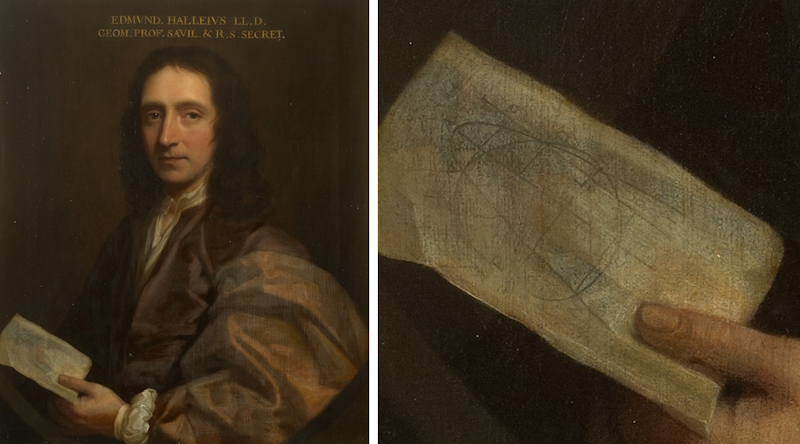 RS.9284, with a close-up of the paper in Halley’s hand
In both paintings, Halley is posed holding a representation of his scientific work. The 1690 portrait (above) shows him with a diagram of an elliptical orbit, a reference to the astronomical research that had defined much of his early scientific career. A catalogue of stars he created while in Saint Helena had helped ensure his election to the Royal Society in 1678 at the age of 22. In 1682 he had made some observations of a comet, and by calculating the orbit he was able to predict its return in 1758. Halley didn’t live to see his theory play out, but ‘Halley’s Comet’ returned just as he had predicted.
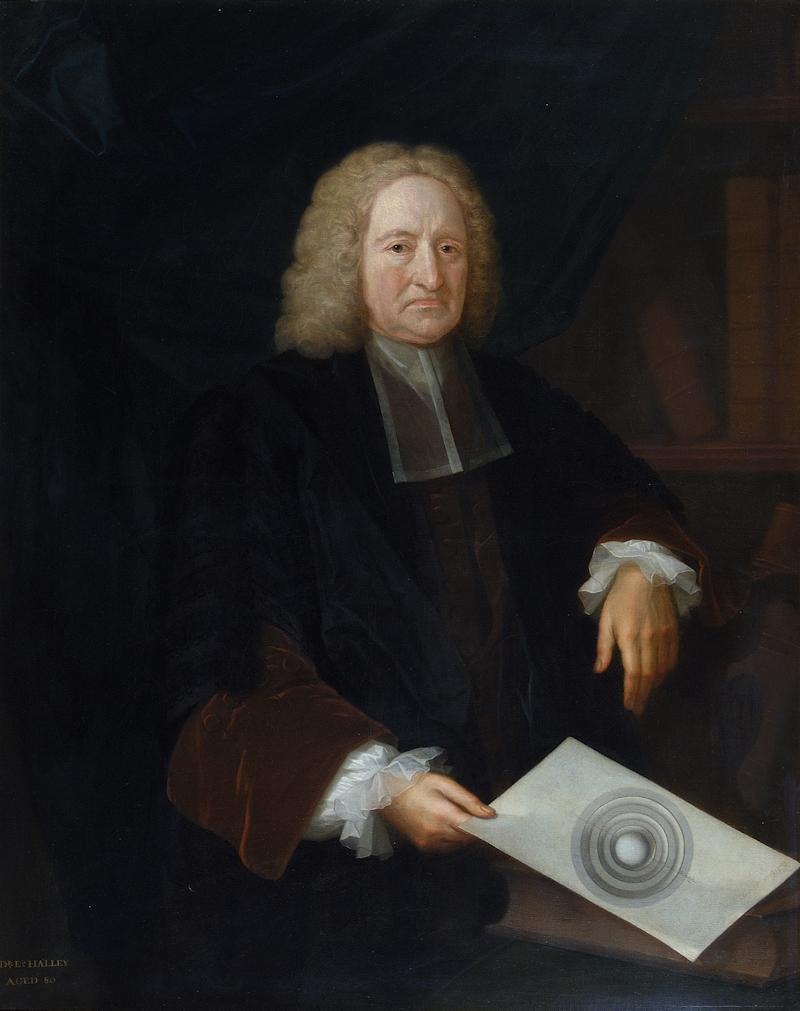
The 1736 painting (above) is perhaps the more interesting of the two, because the figure Halley is holding is not a reflection of his contemporary research agenda at all. Rather, it comes from a paper published in the Philosophical Transactions of the Royal Society back in 1692, under the pithy title of ‘An Account of the cause of the Change of the Variation of the Magnetical Needle. with an Hypothesis of the Structure of the Internal parts of the Earth’. This proposed a unique model for the internal structure of the Earth, to explain why magnetic north was not fixed. The diagram of a sphere, surrounded by three thick concentric circles, represents Halley’s supposed planetary interior, inspired by Saturn’s rings.
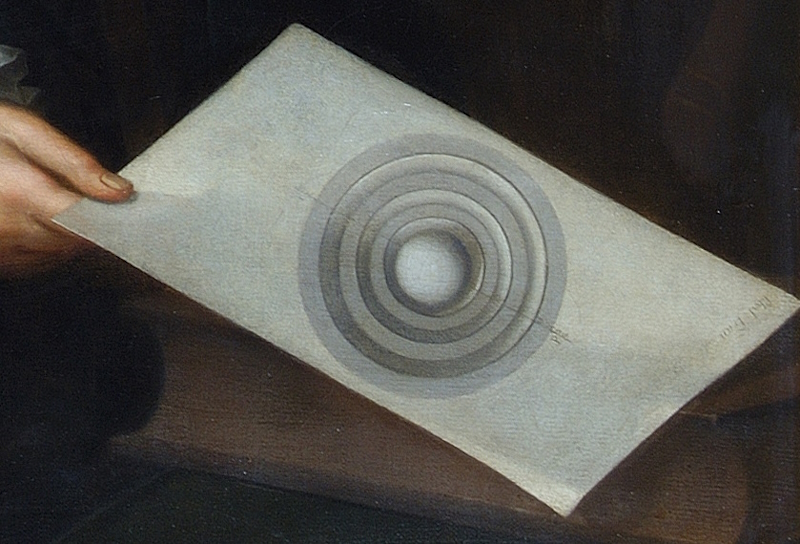 Close-up of the figure held by Halley in the 1736 portrait
Geomagnetism was a significant area of research throughout Halley’s career. He published on the subject in the Philosophical Transactions as early as 1683. The ‘deflection of the Magnetical Needle from the true Meridian’ was of particular interest to Halley, who believed it held the key to solving one of the greatest challenges of the age: how to determine longitude at sea. He later undertook two Atlantic voyages in 1698 and 1699 to measure magnetic declination, and published one of the first isogonic maps as a result. But gathering data was one thing, and explaining it was quite another. Halley conceived his model of the Earth to do just that.
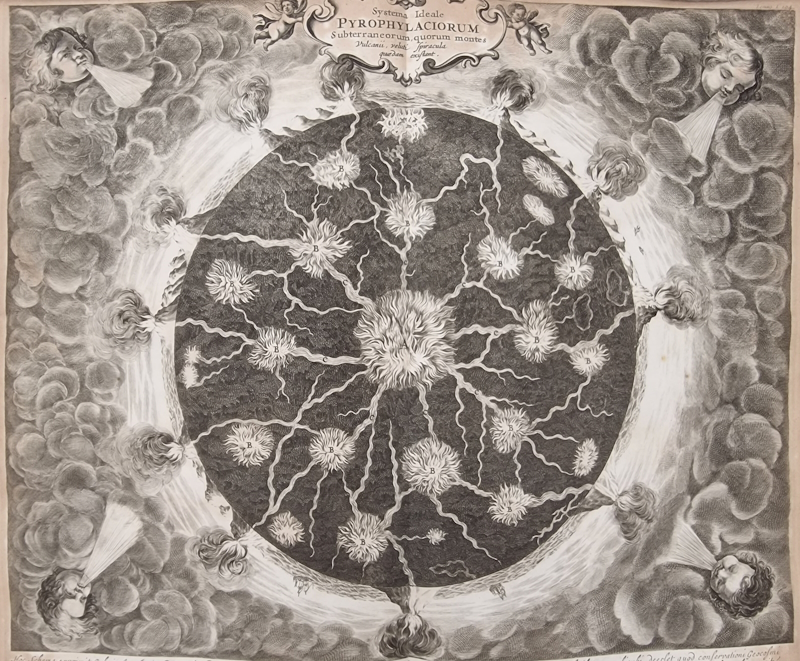
By the seventeenth century, the Earth was understood to be one giant magnet, thanks to William Gilbert’s experiments with terrellae and his publication of De Magnete in 1600. Gilbert suggested that the presence of iron inside the planet might be generating the magnetic field, but beyond this the structure of the interior was a mystery. The German scholar Athanasius Kircher presented one possible model in Mundus Subterraneus in 1664, based on his research on the crater of Vesuvius. He depicted the Earth with a huge ball of fire at its centre, with various channels and underground chambers leading up to volcanoes on the surface:
As we’ve seen, Halley’s model of the Earth’s interior takes the form of a series of hollow spheres around a central core. His argument was that the exterior of the Earth has its own magnetic north and south pole, but that there must be four poles in total. At the centre of his hollow Earth is a core which Halley argued would have its own north and south poles. If that core rotated at a different speed to the exterior, then the interactions between poles would give rise to the changes in magnetic declination observed with a compass. In positing the existence of a central core, Halley was touching upon the truth long before anyone could prove it – the Earth’s core wasn’t conclusively evidenced until 1906, based on measurements of earthquake shockwaves made by Richard Oldham FRS.
Halley read an early version of his paper at a meeting of the Royal Society on 25 November 1691, and presented the figure at the next meeting. A longer version of the essay was then read and ordered for printing in the Transactions at the meeting on 27 January 1692.
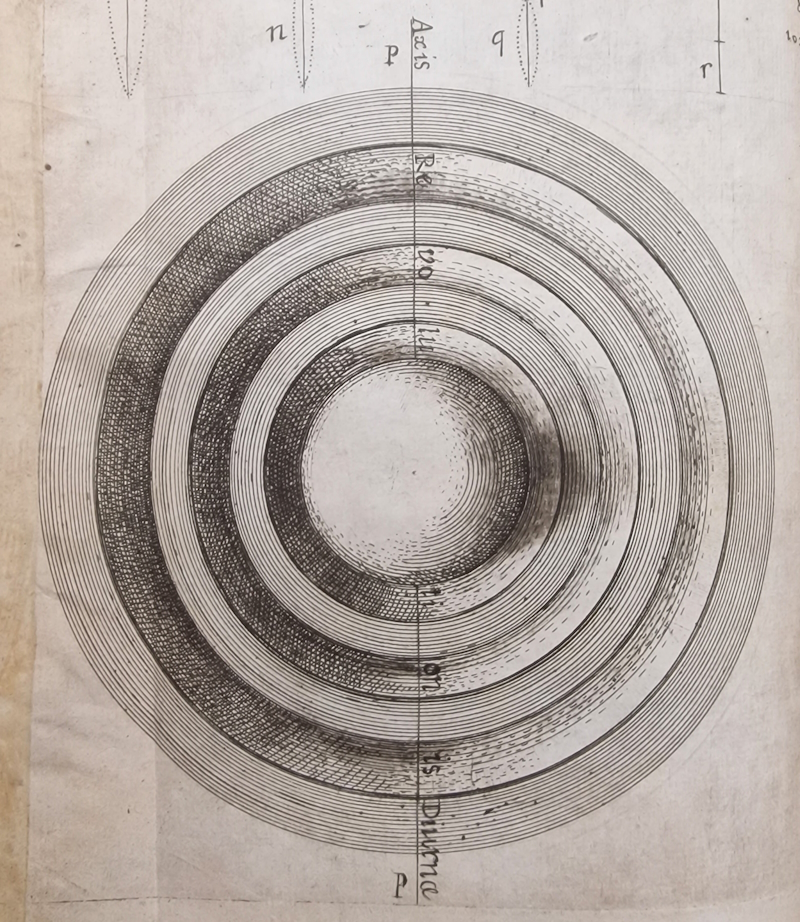 Halley’s Earth diagram as it appeared in the Philosophical Transactions
Astute readers may have noted that Halley explained the magnetic variations with reference to the surface and the core. So why does his figure include multiple layers in between? At this time, it was believed that all the planets must be capable of supporting life, and Halley argued that putting more creations inside the Earth was simply an efficient use of space for an almighty God: ‘We ourselves, in Cities where we are pressed for room, commonly build many Stories one over the other, and thereby accommodate a much greater multitude of Inhabitants’. As for light, he proposed that the very air could be luminous, or that the underside of each shell might shine like the sun.
Halley closed his paper by saying that ‘If this Short Essay shall find a kind acceptance, I shall be encouraged to enquire farther’. Given that he never returned to the subject, it’s fair to speculate he wasn’t thrilled by its reception. Patricia Fara has suggested that this paper was part of Halley’s attempt to boost his religious credentials while (unsuccessfully) applying for a post at Oxford University.
Nevertheless, its inclusion in the portrait many years later hints at Halley’s confidence in his model. No doubt he was hoping that time would prove him right, but it was not to be. The 1774 Schiehallion experiment, which determined the planet’s density, conclusively disproved any hollow Earth theory. Given his extensive body of work, it’s a bit unfortunate that Halley chose to have one of his less successful speculations immortalised on canvas. I’m sure Jules Verne would have approved, however.
Authors



.png)


%20-%20Copy.jpeg)
%20-%20Copy.jpeg)
.jpeg)
.jpeg)
%20-%20Copy%20-%20Copy%20-%20Copy.jpeg)
.jpeg)
%20-%20Copy%20-%20Copy.jpeg)
.jpeg)
.jpeg)
%20-%20Copy%20-%20Copy.jpeg)

.jpeg)
.jpeg)

Stuff
The transcript humorously retells the biblical creation story from a Gnostic perspective, framing God (Yaldabaoth) as an arrogant, flawed being who creates a corrupt material world. The narrative starts with the Monad (the ultimate God) from which emanates the Pleroma (a realm of divine entities known as Aeons). One of these Aeons, Sophia, makes a mistake by creating Yaldabaoth without a partner. Yaldabaoth, unaware of higher divine beings, believes he is the only god and creates the material universe, trapping divine sparks within human beings. The story reinterprets well-known biblical events like the creation of Adam and Eve, the Fall, Cain and Abel, the Flood, and the story of Abraham, all casting Yaldabaoth in a negative light. Gnostic figures such as Sophia and Christ work against Yaldabaoth to liberate humanity from the material world's ignorance.
Outline of Gnosticism
1. Introduction to Gnosticism
- Gnosticism is a collection of ancient religious ideas and systems that emerged in the early centuries of Christianity.
- The term “Gnostic” comes from the Greek word *gnosis*, meaning knowledge, specifically esoteric, spiritual knowledge aimed at transcending the material world.
2. Key Concepts in Gnosticism
- **The Monad and the Pleroma**:
- The Monad is the ultimate, unknowable God, from whom all things emanate.
- The Pleroma is the divine fullness, a realm populated by Aeons, which are divine beings or aspects of the Monad.
- **Sophia’s Fall**:
- Sophia (Wisdom), one of the Aeons, tries to create a being on her own and accidentally brings forth Yaldabaoth, the flawed Demiurge (creator god).
- **Yaldabaoth (Demiurge)**:
- Yaldabaoth is ignorant of the higher realms and believes himself to be the only god. He creates the material universe, which is inherently flawed and corrupt.
- **Dualism**:
- Gnosticism emphasizes the stark contrast between the material world (associated with ignorance and evil) and the spiritual realm (associated with knowledge and goodness).
- **Divine Sparks**:
- Humans contain divine sparks or fragments of the Pleroma trapped within their material bodies. These sparks are the true essence of humanity.
3. **The Gnostic Cosmology**
- **Emanation of Aeons**:
- From the Monad emanates several pairs of divine beings, known as Aeons, each representing various aspects of the divine. Over time, these emanations become less powerful.
- **The Creation of the Material World**:
- The Demiurge (Yaldabaoth) creates the material universe out of ignorance and arrogance, resulting in a flawed and corrupt reality.
- **Archons**:
- Yaldabaoth’s minions, the Archons, serve as gatekeepers of the material world, enslaving human souls and keeping them in ignorance.
4. **The Role of Sophia**
- **Sophia’s Redemption**:
- After creating Yaldabaoth, Sophia realizes her mistake and tries to correct it. In some Gnostic texts, she plays a key role in awakening humanity by helping them recognize their divine nature.
- **Sophia and the Snake**:
- In the Gnostic version of the Garden of Eden story, Sophia (through the serpent) encourages Eve to eat from the tree of knowledge, thus leading to humanity's awareness of the Demiurge’s deception.
5. **Gnostic Interpretation of the Biblical Story**
- **Creation of Humanity**:
- Yaldabaoth creates Adam and Eve and places them in a world of ignorance. The Tree of Knowledge represents the divine truth hidden from them.
- **The Fall**:
- Eating the fruit from the Tree of Knowledge allows Adam and Eve to recognize Yaldabaoth’s deception, leading to their expulsion from the Garden. However, this act is viewed as a positive step towards enlightenment in Gnostic terms.
- **Cain, Abel, and Seth**:
- Cain is portrayed in a more positive light in some Gnostic texts, while Seth is often regarded as the progenitor of a spiritual lineage.
6. **Christ and Salvation in Gnosticism**
- **Christ as the Redeemer**:
- Christ, in Gnostic theology, is a divine Aeon sent from the Pleroma to free humanity from the material world's ignorance.
- **Gnosis and Liberation**:
- Salvation in Gnosticism comes through *gnosis*, or direct, personal knowledge of the divine. By recognizing their divine spark and rejecting the material world's deception, individuals can ascend back to the Pleroma.
7. **Humanity's Struggle**
- **Struggle Against the Archons**:
- Humans must overcome the control of the Archons to attain *gnosis* and return to the Pleroma.
- **Role of Gnostic Figures**:
- Figures like Christ, Sophia, and other Aeons work to guide and assist humanity in this spiritual journey.
8. **Gnostic Views on Biblical Characters and Stories**
- **Yaldabaoth’s God Complex**:
- Yaldabaoth is seen as a tyrant, and many biblical stories (e.g., Cain and Abel, Noah, and Abraham) are retold in a way that portrays God as a flawed, deceptive being.
- **Alternate Readings**:
- Gnostic interpretations of events like the Flood or the destruction of Sodom often involve resistance against Yaldabaoth’s oppressive rule.
9. **The Endgame in Gnosticism**
- **Final Liberation**:
- The ultimate goal of Gnosticism is for humanity to awaken to its true nature and escape the material world.
- **Mutual Stalemate**:
- Gnostic stories often end with a balance of power between Yaldabaoth and the Pleroma, with humans playing a crucial role in the ongoing struggle for spiritual liberation.
This expanded outline integrates Gnostic cosmology, philosophy, and interpretations of traditional biblical stories, positioning Gnosticism as a radical reinterpretation of the creation myth with a focus on liberation from material existence.
Save Libraries /#internetarchiveisawesome
Policy
Why a ruling against the Internet Archive threatens the future of America’s libraries
The decision locks libraries into an ecosystem that is not in readers' interests. Congress must act.
Chris Lewis
September 11th, 2024
Stephanie Arnett/MIT Technology Review | NYPL (lion), Adobe Stock, Envato
I was raised in the 1980s and ’90s, and for my generation and generations before us, the public library was an equalizing force in every town, helping anyone move toward the American dream. In Chantilly, Virginia, where I grew up, it didn’t matter if you didn’t have a computer or your parents lacked infinite money for tutors—you could get a lifetime’s education for free at the public library. A ruling from the US Second Circuit against the Internet Archive and in favor of publisher Hachette has just thrown that promise of equality into doubt by limiting libraries’ access to digital lending.
To understand why this is so important to the future of libraries, you first have to understand the dire state of library e-book lending.
Libraries have traditionally operated on a basic premise: Once they purchase a book, they can lend it out to patrons as much (or as little) as they like. Library copies often come from publishers, but they can also come from donations, used book sales, or other libraries. However the library obtains the book, once the library legally owns it, it is theirs to lend as they see fit.
Not so for digital books. To make licensed e-books available to patrons, libraries have to pay publishers multiple times over. First, they must subscribe (for a fee) to aggregator platforms such as Overdrive. Aggregators, like streaming services such as HBO’s Max, have total control over adding or removing content from their catalogue. Content can be removed at any time, for any reason, without input from your local library. The decision happens not at the community level but at the corporate one, thousands of miles from the patrons affected.
Then libraries must purchase each individual copy of each individual title that they want to offer as an e-book. These e-book copies are not only priced at a steep markup—up to 300% over consumer retail—but are also time- and loan-limited, meaning the files self-destruct after a certain number of loans. The library then needs to repurchase the same book, at a new price, in order to keep it in stock.
This upending of the traditional order puts massive financial strain on libraries and the taxpayers that fund them. It also opens up a world of privacy concerns; while libraries are restricted in the reader data they can collect and share, private companies are under no such obligation.
Some libraries have turned to another solution: controlled digital lending, or CDL, a process by which a library scans the physical books it already has in its collection, makes secure digital copies, and lends those out on a one-to-one “owned to loaned” ratio. The Internet Archive was an early pioneer of this technique.
When the digital copy is loaned, the physical copy is sequestered from borrowing; when the physical copy is checked out, the digital copy becomes unavailable. The benefits to libraries are obvious; delicate books can be circulated without fear of damage, volumes can be moved off-site for facilities work without interrupting patron access, and older and endangered works become searchable and can get a second chance at life. Library patrons, who fund their local library’s purchases with their tax dollars, also benefit from the ability to freely access the books.
Publishers are, unfortunately, not a fan of this model, and in 2020 four of them sued the Internet Archive over its CDL program. The suit ultimately focused on the Internet Archive’s lending of 127 books that were already commercially available through licensed aggregators. The publisher plaintiffs accused the Internet Archive of mass copyright infringement, while the Internet Archive argued that its digitization and lending program was a fair use. The trial court sided with the publishers, and on September 4, the Court of Appeals for the Second Circuit reaffirmed that decision with some alterations to the underlying reasoning.
This decision harms libraries. It locks them into an e-book ecosystem designed to extract as much money as possible while harvesting (and reselling) reader data en masse. It leaves local communities’ reading habits at the mercy of curatorial decisions made by four dominant publishing companies thousands of miles away. It steers Americans away from one of the few remaining bastions of privacy protection and funnels them into a surveillance ecosystem that, like Big Tech, becomes more dangerous with each passing data breach. And by increasing the price for access to knowledge, it puts up even more barriers between underserved communities and the American dream.
It doesn’t stop there. This decision also renders the fair use doctrine—legally crucial in everything from parody to education to news reporting—almost unusable. And while there were occasional moments of sanity (such as recognizing that a “Donate here” button does not magically turn a nonprofit into a commercial enterprise), this decision fractured, rather than clarified, the law.
If the courts won’t recognize CDL-based library lending as fair use, then the next step falls to Congress. Libraries are in crisis, caught between shrinking budgets and growing demand for services. Congress must act now to ensure that a pillar of equality in our communities isn’t sacrificed on the altar of profit.
Chris Lewis is president and CEO of Public Knowledge, a consumer advocacy group that works to shape technology policy in the public interest. Public Knowledge promotes freedom of expression, an open internet, and access to affordable communications tools and creative works.
Read next
What Japan’s “megaquake” warning really tells us
Robin George Andrews
How the US and its allies can rebuild economic security
Edlyn V. Levine, Fiona Murray
Why China’s dominance in commercial drones has become a global security matter
Zeyi Yang


